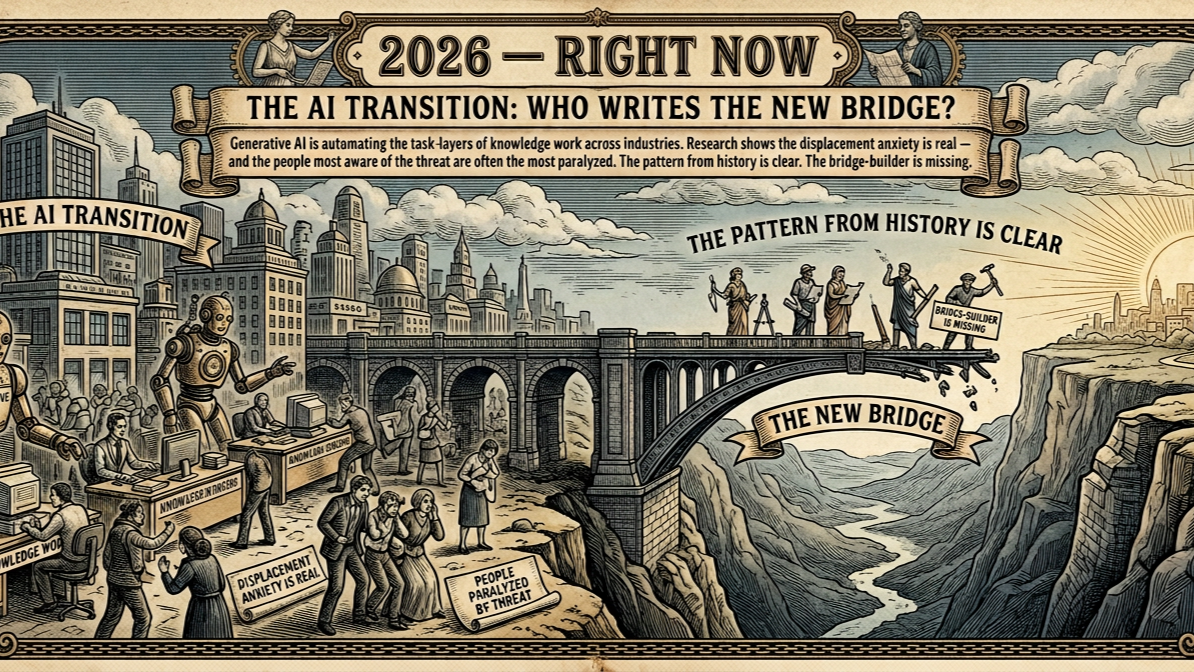
What 2,100 years of workforce disruption can teach us about the moment we’re in right now
A few weeks ago I was talking to an office manager who had spent fifteen years keeping a mid-sized company running. Scheduling, vendor relationships, on-boarding new hires, making sure the right people were in the right rooms at the right times, absorbing the chaos that nobody else had a job title for. Smart. Experienced. Genuinely good at her job.
She wasn’t panicking. She was doing something quieter and more corrosive than that: she was explaining, carefully and methodically, why nothing she knew how to do would matter anymore.
I’ve had versions of that conversation with analysts and factory workers, with customer service veterans and instructional designers, with people who’ve spent their careers doing precise physical work and people who’ve spent theirs doing precise cognitive work. The specific job varies. The underlying shape of the fear is identical: AI is going to do what I do, only faster and cheaper, and I have no idea what I become after that.
That fear is rational. The paralysis it produces is not. And the reason people get stuck isn't a lack of information about AI — it's a lack of a frame for themselves.
History has that frame. The dots are scattered across 2,100 years, and they’re genuinely hard to connect — but once you connect them, the picture is hard to unsee.
Consider the ancient Romans
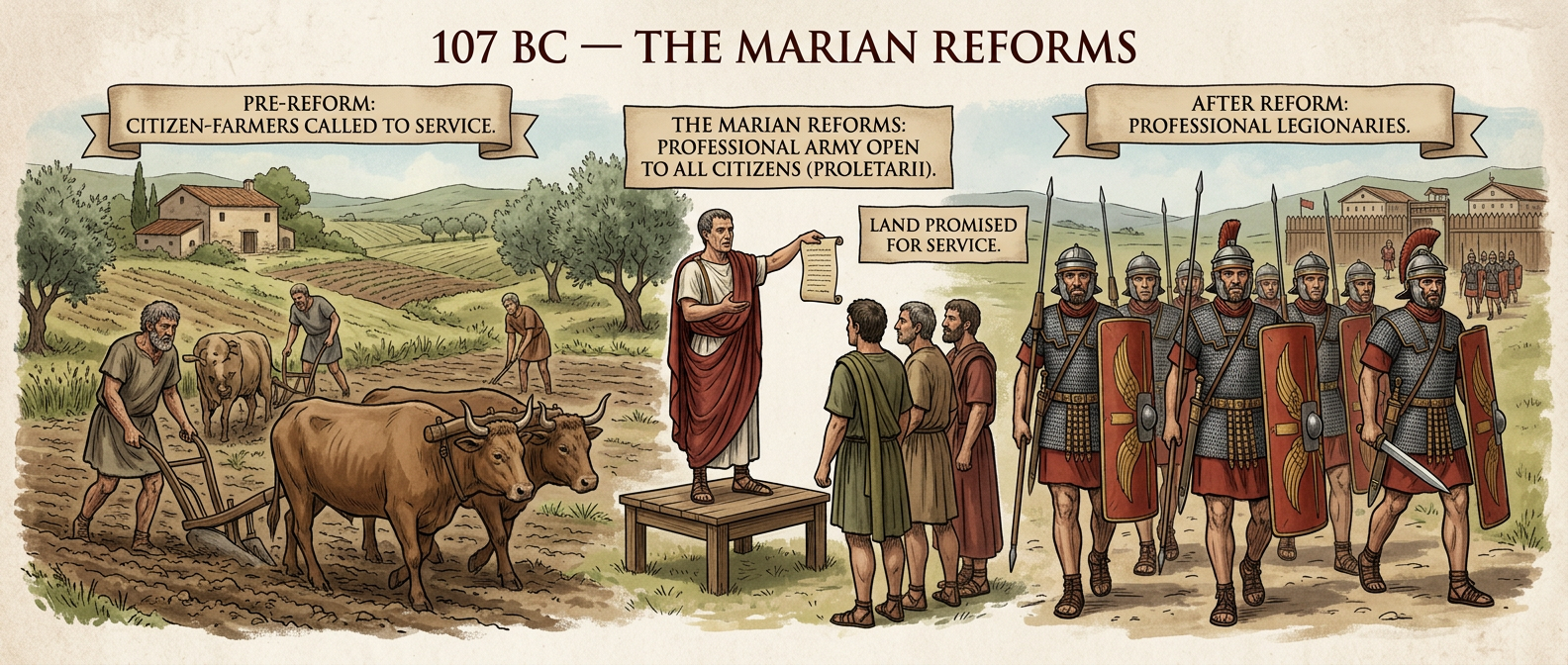
In 107 BCE, the Roman economy was in the middle of a crisis that sounds uncomfortably familiar. Cheap grain flooding in from conquered territories had destroyed the small-farm class that had always supplied Rome’s armies. A generation of landless workers had no civic role, no income, no path forward. They were economically displaced by forces entirely outside their control — globalization, essentially, with different geography.
A general named Gaius Marius had an army to staff and a war to fight, and the traditional pool of recruits had evaporated.
What Marius did next was not, on the surface, complicated. He opened the legions to the landless poor — the capite censi, men who had been formally excluded from military service because they couldn’t afford their own equipment. He standardized everything: weapons, training, doctrine. He created a career arc where none had existed — sixteen years of service, veterans teaching recruits, and at the end of it, a land grant. A future to inhabit.
He didn't just retrain people. He gave them a new identity with a visible path to a destination.
In the process, he accidentally invented the professional army, transformed Roman society, and — in one of history’s great unintended consequences — set the conditions for Julius Caesar. But that’s a different article.
The point is the structure of what he did. And the fact that we have seen it again and again since.
Three more examples. Same three moves each time.
1933. The Great Depression.
Youth unemployment exceeded 25% nationally and approached 60% in some regions. A generation of young men was drifting, structure-less, purposeless. Franklin Roosevelt’s Civilian Conservation Corps didn’t ask for credentials. It set the barrier to entry at exactly the level that included everyone who needed it: physical ability and willingness to show up.
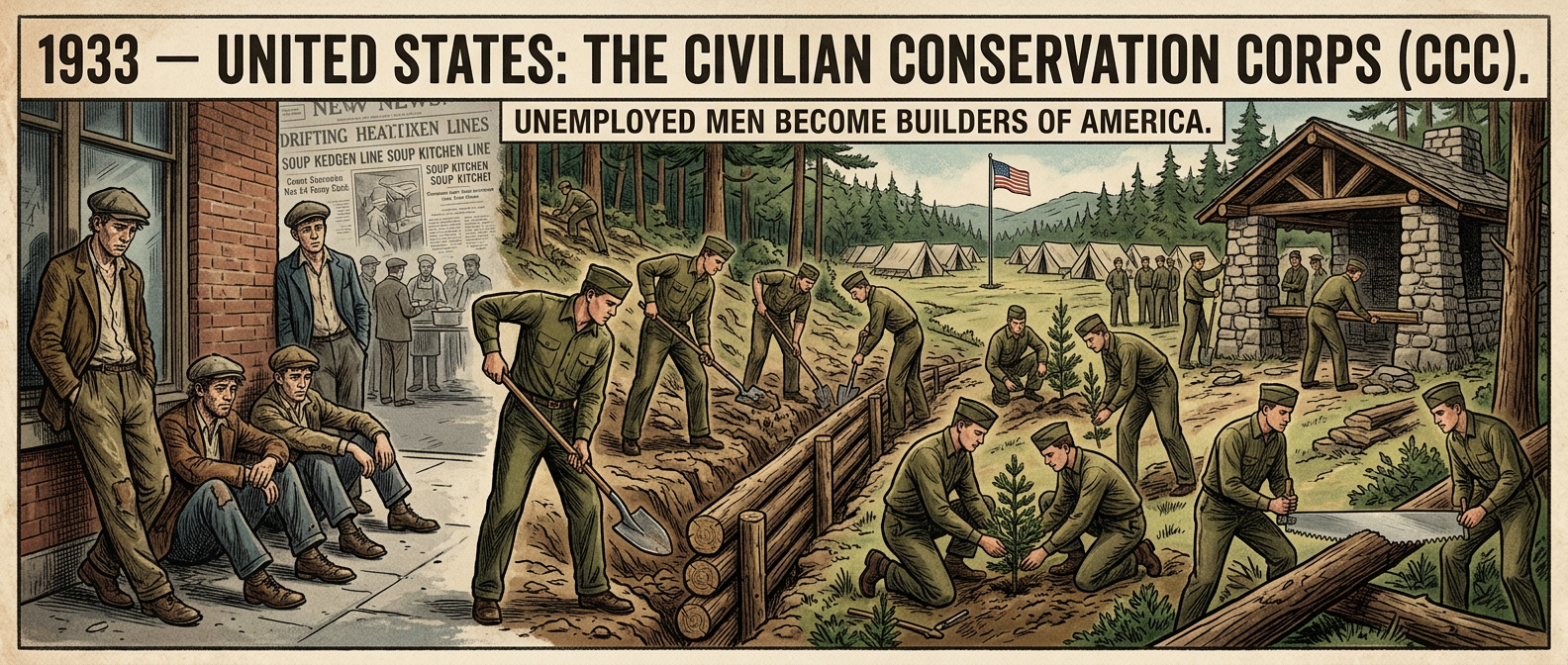
What it gave them: structure, belonging, food, housing, training, job placement — and a landscape transformed by three billion trees planted over nine years. Between 1933 and 1942, the CCC enrolled three million men. One third of all American men aged 17 to 24.
That number is worth sitting with. **One third of a generation, rerouted.**
The key move wasn’t the work. It was structure and belonging arriving before the credential. Purpose first. Pathway second.
**Then and now.** Youth unemployment among 20-to-30-year-olds in tech-exposed occupations rose nearly 3 percentage points in early 2025 alone — notably higher than peers in other fields, and corroborated by widespread reports of AI contributing to hiring headwinds for recent graduates. The CCC generation faced comparable numbers. The question is whether this generation gets a comparable response.
1944. Sixteen million soldiers coming home.
Congress remembered what had happened in 1932, when WWI veterans marched on Washington in desperation — the Bonus Army, dispersed by force. They were determined not to repeat it.
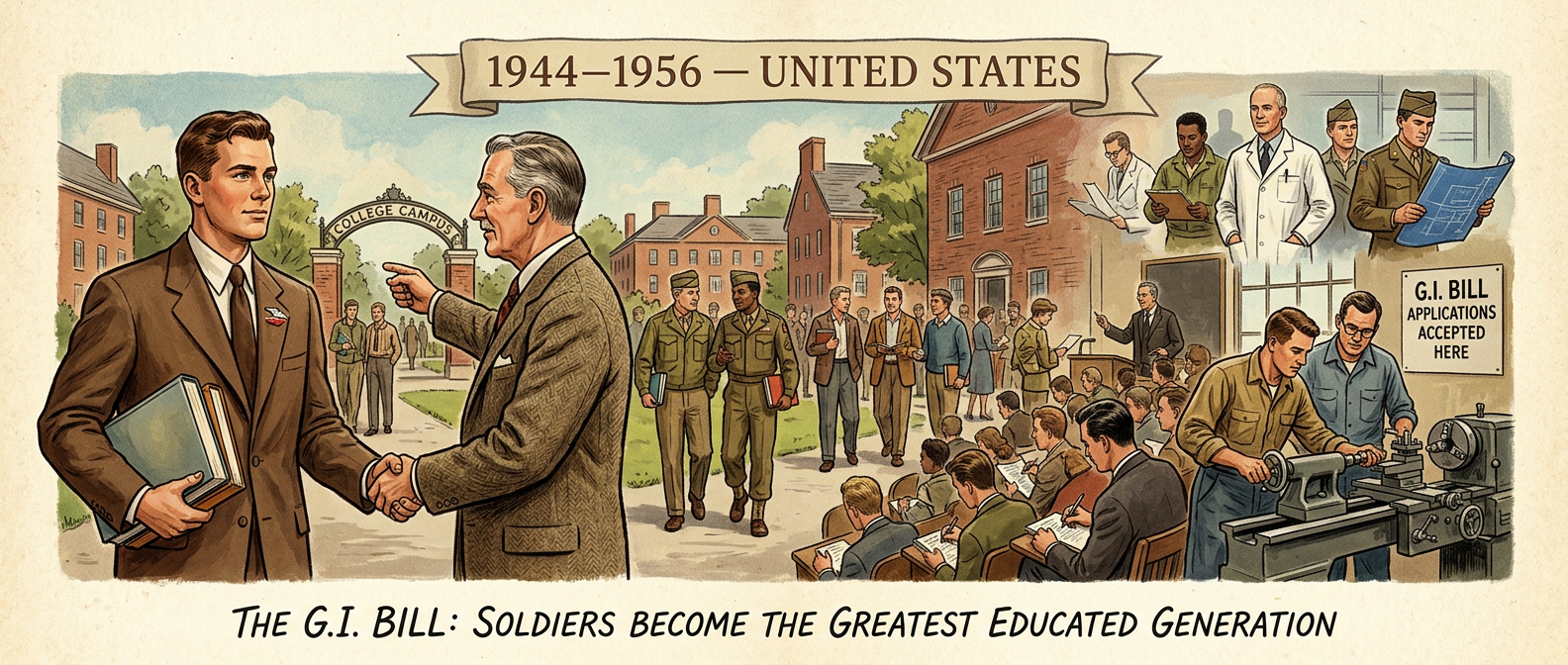
The GI Bill — the Service-men’s Readjustment Act of 1944 — didn’t ask “what can these men do now?” It asked “what do they want to become?” and funded the answer. For eight million veterans who used its educational provisions, it opened access to futures that had been structurally unavailable to them before.
Historians estimate that for every dollar invested, the U.S. economy returned seven. American universities transformed from elite institutions into engines of broad social mobility. The greatest generation didn’t inherit their postwar prosperity. They earned it through a system specifically designed to make that possible.
The investment was in future identity, not present relief.
The home front, 1942.
Sixteen million men had entered military service. Defense industries across the Allied nations faced a labor shortage with no historical precedent. Women had been systematically excluded from industrial work for generations — and most had never thought of themselves as industrial workers at all.
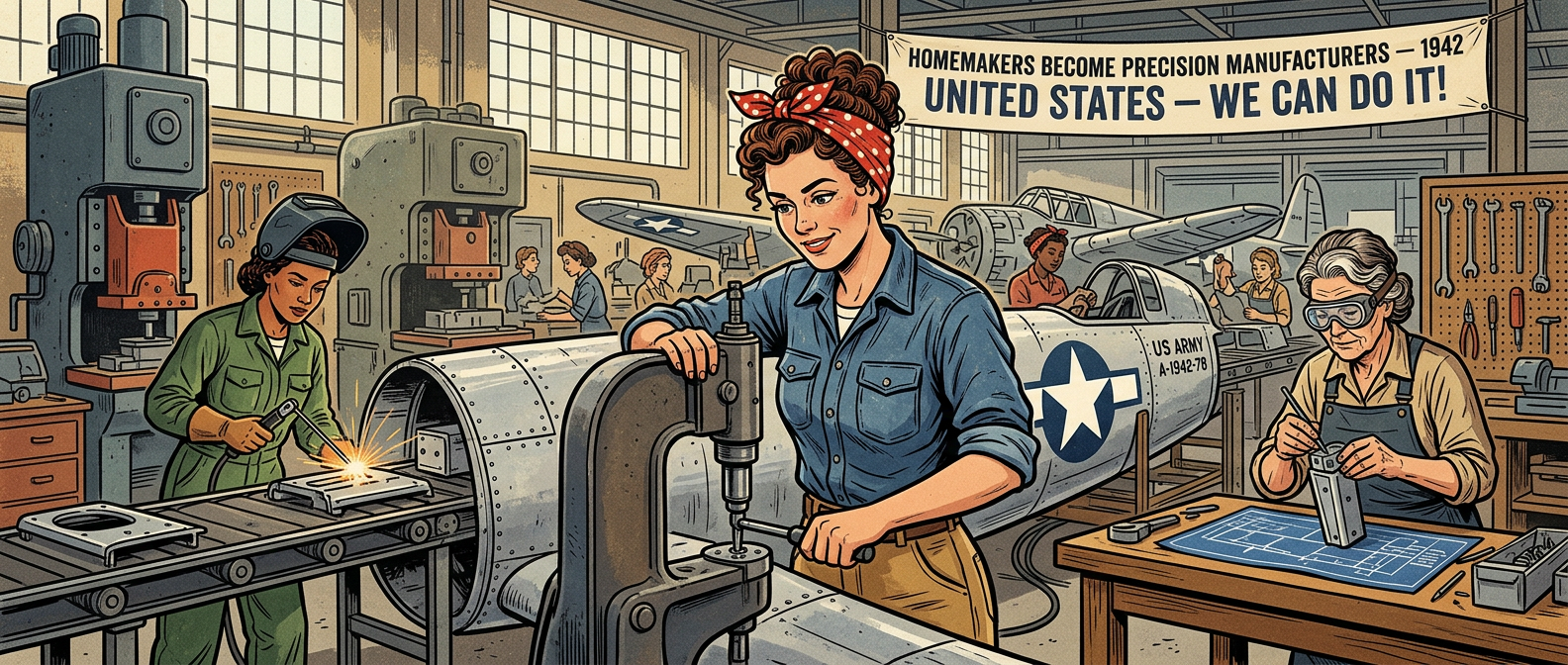
The Rosie the Riveter campaign did something that looks simple in retrospect and was genuinely remarkable in practice. It didn’t ask women to acquire new skills. It gave them a new frame for skills they already had.
*If you can sew, you can rivet. If you can put together a pie, you can work an assembly line.*
The skills hadn’t changed. What changed was the interpretive lens — the way those skills were seen, named, and valued. Women didn’t discover previously hidden capabilities. They were handed a translation: here is what your existing capability looks like in this new context. The bridge wasn’t training. It was recognition, followed by re-framing.
And it worked because it was true. Between 1940 and 1945, women's share of the U.S. workforce grew from 27 to nearly 37 percent. More than 310,000 women worked in the aircraft industry alone in 1943 — 65 percent of that industry's total workforce, up from one percent before the war.
The re-frame was accurate. The capability was real. The campaign just named it in a language that connected.
The three moves
Look across all four cases. The pattern is hard to miss.
- Move one: Name the crisis honestly. Not “change is coming” or “the future is bright.” The actual crisis, in plain language, without minimizing what’s being lost. Marius didn’t pretend the farms were coming back. Roosevelt didn’t pretend the Depression was temporary. Nobody told the women working defense lines that it would be easy or that nothing would be asked of them.
- Move two: Build the bridge from existing identity. Every successful transition found a way to connect who people already were to who they were becoming. The Roman farmer’s endurance translated into the legionary’s discipline. The homemaker’s precision translated into the riveter’s accuracy. The veteran’s capacity to operate under pressure translated into the university student’s rigor. Nobody was asked to become someone unrecognizable. They were shown that they already were, in some essential way, who they needed to become. The frame shifted. The person didn’t have to.
- Move three: Name a destination worth walking toward. A land grant. A built landscape. A college degree. Something specific, achievable, and worth the discomfort of transition. Not “you’ll be okay” — a future identity to grow into.
What failed — post-industrial towns, communities hollowed out after factory closures — skipped moves one and two and jumped straight to three. “Here’s a retraining program.” Nobody acknowledged what was being lost. Nobody connected who people were to where they were going. The program felt like an insult, because in a meaningful sense it was: it assumed the problem was skills, when the actual problem was identity.
A brief note on David Ogilvy and high ground
There’s an etymological footnote I can’t resist.
The name Ogilvy — as in David Ogilvy, who built one of the twentieth century’s most influential advertising agencies and essentially codified modern brand identity — traces back to the Pictish-Gaelic Ocel-fa, meaning “high plain” or “elevated ground.” The man literally named for high ground spent his career teaching brands how to claim it.
His most repeated principle was something like this: the consumer is intelligent. Speak to them as though they are, and they’ll trust you. Speak to them as though they aren’t, and they’ll know immediately.
The Rosie campaign was Ogilvy before Ogilvy existed. It didn’t condescend. It didn’t simplify. It said: you already know this — you just didn’t know it applied here. That’s the highest form of persuasion: not manufacturing belief, but translating existing reality into a new frame. The capability was already present. The campaign made it legible in a new context.
The organizations that figure out how to do that for their workers in the AI transition won’t just survive the disruption. They’ll claim the high ground.
Which brings us here
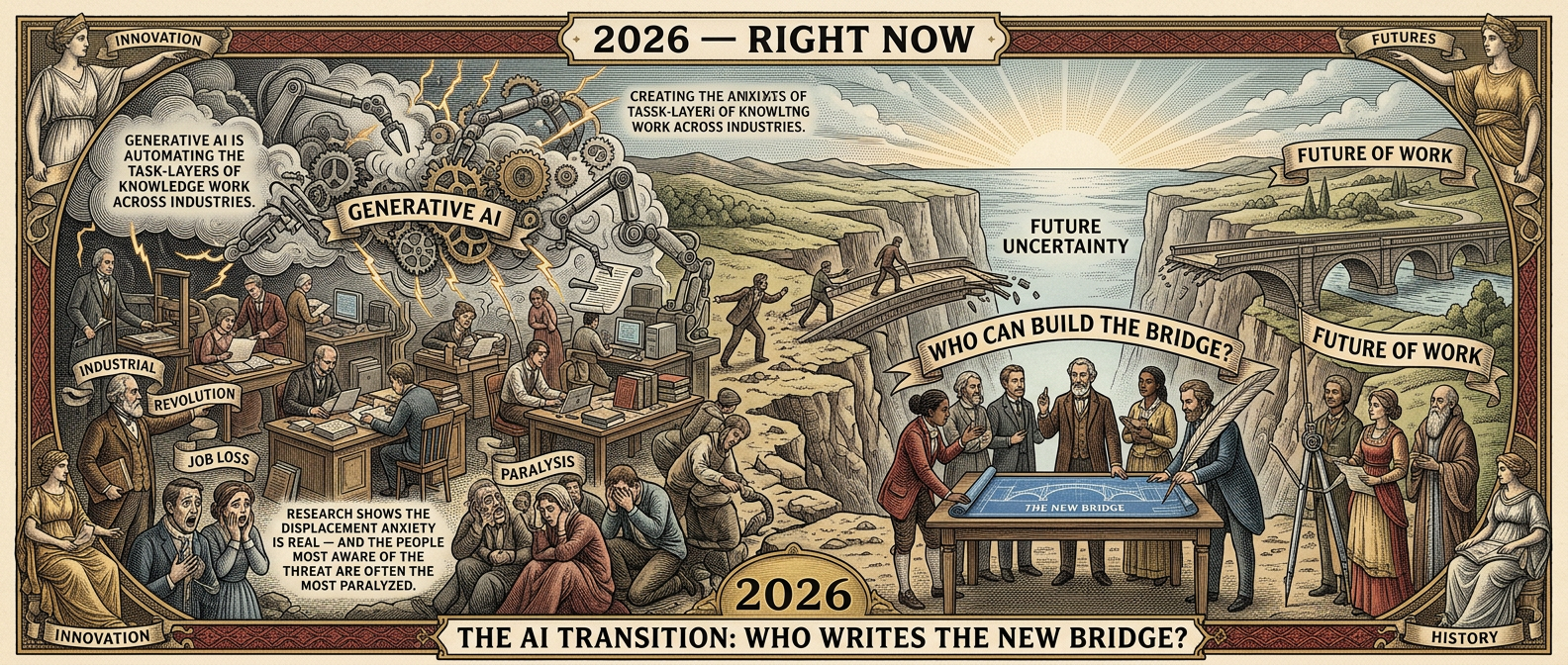
Research on AI-induced job displacement has now documented the psychological response pattern in affected workers. Six recurring themes emerge: emotional shock, erosion of professional identity, chronic anxiety and anticipatory rumination, social withdrawal, maladaptive coping, and perceived organizational betrayal.
**That is worth repeating. Six recurring themes emerge: **
- *emotional shock *
- erosion of professional identity
- chronic anxiety and anticipatory rumination
- social withdrawal
- maladaptive coping
- perceived organizational betrayal
Notice what leads. Not “concern about income.” Not “worry about the job market.” Shock and identity erosion come first. The wound is existential before it’s economic — and this is true across job types, across industries, across education levels. The office manager I opened with and the factory line worker I spoke to last month are having structurally identical experiences, even though their work couldn’t look more different from the outside.
This is the Rosie problem, inverted. In 1942, women had capability they didn't know translated to industrial work — the campaign revealed a bridge that already existed. In 2026, workers across every category of employment have capability they don't realize survives AI — and the campaign that shows them hasn't been run.
The World Economic Forum reports that 41 percent of employers intend to reduce their workforces by 2030 due to AI. The workers most aware of the threat are consistently the most paralyzed by it. Knowledge, in this case, is producing anxiety faster than it’s producing action.
That is not a skills problem. That is a narrative problem. Specifically, a translation problem — the same kind the Rosie campaign solved in 1942.
The question that opens the bridge
I’ve been asking people a version of three questions. What do you actually do — not your job title, but what you genuinely spend time doing? What’s the disruption you’re facing? And then the hard one: what do you know that the AI doesn’t?
That third question is where things get interesting, and where I consistently see people surprise themselves.
Not “what can’t AI do” — that’s a technical argument and it moves too fast. But what do you know that lives outside the document, outside the dataset, outside the transcript? The judgment call you make at 4pm on a Friday that nobody could have trained a model on because it required knowing which customer was three months from canceling and which one was just having a bad day. The inventory decision that required remembering what happened two winters ago with a supplier who went quiet before they went under. The way a new hire’s body language in week three tells you something the on-boarding survey will never capture.
That’s not a soft skill. That’s the residue of genuine expertise, which is always partly tacit, always partly relational, always partly about stakes. AI systems don’t have skin in the game. They don’t bear consequences. They don’t carry the weight of having been wrong before and knowing exactly what that cost. They can generate the document. They cannot yet own what it means to sign it.
Most people have extensible skills. Most people are absurdly unaware of it. Not because they’re not intelligent — but because nobody has handed them the translation. They’ve been carrying capability in one frame, and the new context requires a different label for the same underlying thing. The sewing is the riveting. The scheduling is the orchestration. The line work is the quality judgment. The translation exists. The campaign to deliver it does not.
The bridge doesn’t say “don’t worry, AI won’t replace you.” That’s a platitude, and people see through it in seconds.
The bridge says: *here is the specific thing you carry that doesn't get automated — named precisely, connected to the direction you're heading, with a path under your feet.*
The organizations that get this right
The companies that treat the AI transition as solely a skills inventory problem are going to lose the workers who matter most. The workers with the deepest tacit knowledge — the ones who carry institutional wisdom, relationship context, judgment honed over years of consequence — are exactly the ones who feel most threatened by AI, and exactly the ones who will disengage or leave first if they don’t see a path forward.
The organizations that navigate this well will do something structurally similar to what worked historically. They’ll name the crisis honestly. They’ll build bridges from existing identity to new roles — not just training catalogs, but actual narrative connective tissue that shows people how who they already are maps to where they’re going. And they’ll invest in future identity, not just present relief.
Learning platforms built for this moment aren’t content libraries. They’re orientation systems. They don’t just ask “what do you need to learn?” They ask “who are you becoming, and what path leads there from where you stand right now?”
That’s the GI Bill question. It worked spectacularly once. It works now.
The bridge is yours to write
None of the bridge-builders I’ve described were acting from a grand theory of workforce transformation. Marius needed soldiers and had to find them somewhere. Roosevelt needed to keep a generation of young men from drifting into crisis during an economic catastrophe. The Rosie campaign needed factory workers and had one massive, untapped, systematically underestimated source.
The bridges got built because the people building them were honest about the problem, precise about the connection, and specific about the destination. And because they treated the people crossing them as intelligent adults who could make the journey — if someone just showed them that they already had what it took.
The AI transition is real. The displacement is real. The identity erosion is real. And somewhere between “everything is fine” and “you will be replaced,” there is a bridge that can be built from honest materials, using the same three moves that have worked across twenty-one centuries of disruption.
The question isn’t whether the bridge can be built. The question is who builds it.
→ The Bridge Builder — an interactive companion to this article — takes you through the same three moves, applied to your specific situation. Answer three honest questions. Get back a bridge statement that names what you carry and points toward where you’re going. Explore each historical era in detail. See your moment in the pattern.
**Try it at **poqpoq.com/adobe/bridge-builder/
Dr. Allen Partridge is Director of Digital Learning Product Evangelism at Adobe, leading evangelism for Adobe Learning Manager. He has spent thirty years at the intersection of technology, learning design, and human adaptation — and is increasingly convinced that the most important skill in the AI era is knowing what you already know.
Let’s keep this going:
What’s your answer to question three? What do you carry that lives outside the dataset? Drop it in the comments — I read every one.