On unbuilt academies, the prep tax, and what becomes possible when building is nearly free
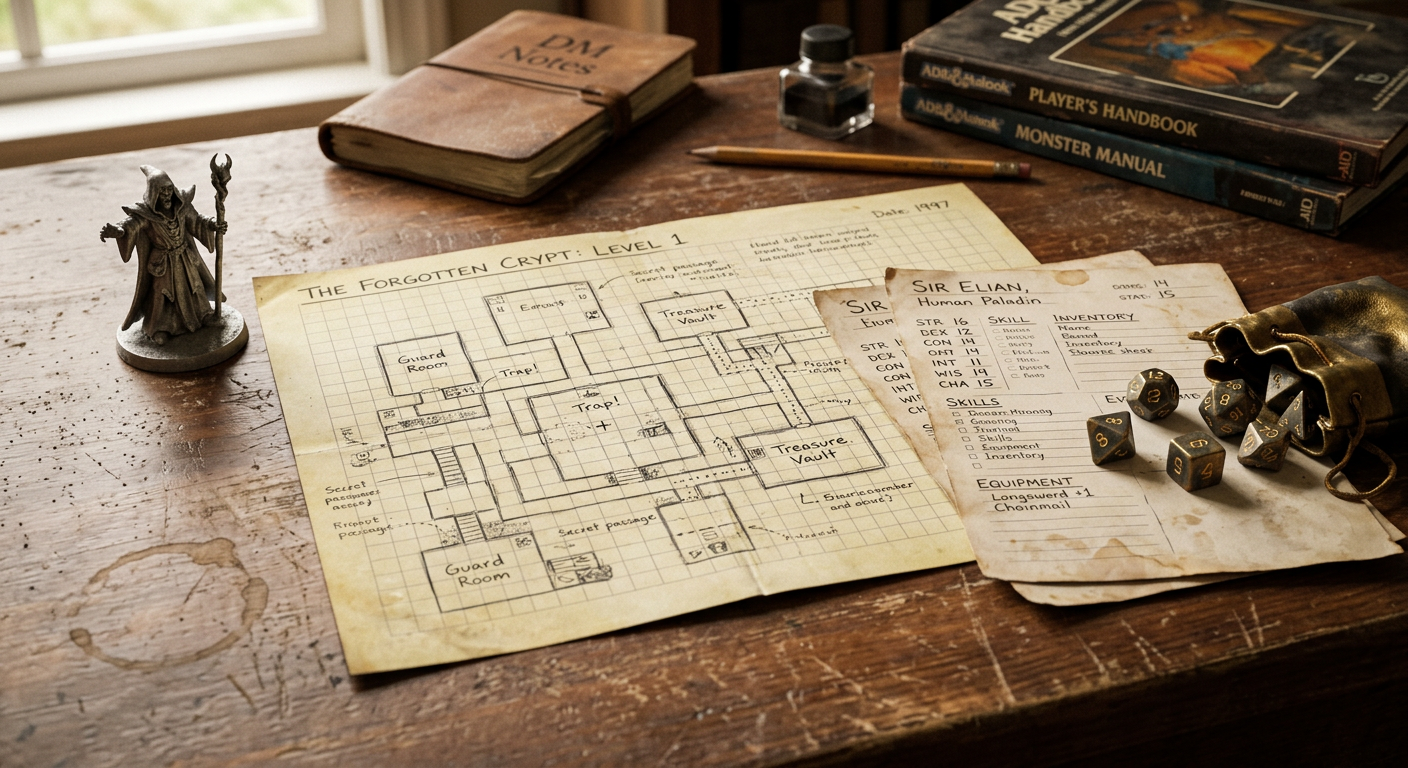
Somewhere in your house — or in a folder on a hard drive you haven’t opened in three years — there is a campaign you never ran.
You statted out the villain. You drew the map of the first dungeon, the little square rooms with dotted lines for the secret passages. You wrote a hook for the players you didn’t yet have. Maybe you bought the miniatures. Maybe you printed the handouts on the good cardstock, the kind that feels like you mean it.
And then life happened. Schedules didn’t align. The session zero never got scheduled. Somebody moved. The energy that brought the campaign into being couldn’t quite carry it across the threshold of actually being played. So it sits where you left it, fully imagined, never lived.
Every Dungeon Master has one of these. Most have several.
I want to talk about the L&D version of that drawer.
The shadow portfolio
Here’s something I’ve come to believe after twenty-five years in learning and development: every L&D leader has the same drawer.
Not literally a campaign — but a portal that was supposed to launch for a specific partner segment. An academy mapped out for an emerging market. A microsite designed for the product release that ended up being a webinar instead. A co-branded experience for your top-tier resellers that made it as far as a slide deck and a kickoff meeting and then quietly stopped existing. A regional hub for distributors in three countries you’ve been “about to invest in” for two fiscal years running.
Every one of these was a real idea. Most of them were good ideas. They had business cases. Champions. Someone, somewhere, said “we should do that.” And then something else happened to them.
If you’ve spent any time in this work, you can probably name three or four right now without trying very hard. The salon-owner academy you sketched out for that consumer-products acquisition. The dealer-engagement program that got scoped down to a quarterly newsletter. The healthcare-professional certification track that lost to a more politically funded initiative. The launch microsite that would have made last quarter’s product release land harder than it did.
These aren’t failures. Failures are the campaigns that ran and went badly. Failures you can learn from. The shadow portfolio is different. It’s the campaigns that never got to fail — that died in scoping meetings, on prioritization grids, in the gap between what was needed and what could be afforded.
Most L&D conversations focus on the experiences that did ship. I want to spend an hour with you on the ones that didn't.
Why campaigns don’t run
Here’s the thing every DM eventually figures out: campaigns don’t fail to run because the DM lacked imagination.
The villain was great. The dungeon was tight. The world had texture and stakes and an NPC the players would have loved. None of that is why the campaign sits in the drawer.
Campaigns don’t run because of the prep tax. The four hours of preparation behind every one hour of play. The maps, the encounter balancing, the handouts, the planning to make spontaneity possible. Every DM eventually has to confront the same brutal arithmetic: if a four-session arc requires twenty hours of prep, and I have two hours a week, then the campaign requires ten weeks of evenings I don’t actually have. The math does what math does.
They don’t run because of the party-size problem. You can’t justify the prep cost for a one-shot with two players. You can’t sustain a campaign for fifteen. Every party size below or above the sweet spot makes the math worse.
They don’t run because of the session-zero problem. Getting six adults in a room at the same time, on a recurring schedule, with their phones away and their attention available. The logistics of starting are sometimes harder than the logistics of playing.
And they don’t run because of DM bandwidth. There’s one of you. You can run one campaign at a time. The other three campaigns waiting in your head are not, technically speaking, available to your players.
Now look back at the L&D version.
The partner academy didn’t get built because the build cost was too high relative to the audience. Six figures of agency time and dev work for a portal that would serve five thousand resellers, when the competing initiative was a flagship academy serving fifty thousand customers. The math chose for you.
The regional hub didn’t ship because the audience size couldn’t justify the prep. Eight thousand learners in a market you were “still proving” wasn’t a number that survived prioritization. It got declared not worth serving — not because nobody wanted to serve them, but because the unit economics were broken.
The launch microsite didn’t happen because the session zero never came together. Marketing wanted it, product wanted it, sales wanted it, and every one of them wanted it slightly differently. The kickoff meeting that was supposed to align everyone is on someone’s calendar. Has been, for fourteen months.
And the rest of the shadow portfolio? DM bandwidth. You have one platform team. They can build one academy at a time. The other six academies waiting in your strategy deck are not, technically speaking, available to your business.
The shape of the constraint
What I want you to notice — and this is the hinge of the whole argument — is that none of those reasons are about the value of the unbuilt experiences. They’re about the cost of bringing them into existence.
For ten years, the technology stack of external learning forced an uncomfortable choice. You could ship fast on out-of-the-box templates and look like every other LMS — fine for internal compliance, deeply wrong for a partner-facing brand experience. Or you could commission a real build: an agency, a professional development team, an implementation partner, a six-figure statement of work, a multi-month engagement, a project plan with twelve named stakeholders and a steering committee that met every other Tuesday. There was no middle.
The cosmetics firm running a paid certification academy for forty thousand salon owners? Dedicated implementation team, multi-month engagement, the kind of project that has its own internal codename and its own Slack channel. The Japanese automaker training twenty-nine thousand dealer staff with rewards, recognition, and integrated performance data? An external partner, a year-long engagement, a budget large enough that someone had to defend it to a finance committee. The chip manufacturer enabling twenty thousand channel partners across geographies? Years of dev-team investment, ongoing custom work, the kind of relationship where the agency knows your roadmap before you do.
These academies exist. They’re impressive. They’re also the size of academy that justifies the engagement.
The shadow portfolio — yours, mine, every L&D leader’s — is full of academies that would have been just as valuable per learner but couldn’t justify the same investment because the audience was smaller, the duration was shorter, the certainty was lower, or the political wind was wrong. You can’t get a steering committee approved for an experimental academy. You can’t justify a six-month engagement for a regional pilot you’re not sure will work. You can’t put a dev team on a microsite that will retire in six weeks.
So those experiences didn’t get built. Not because nobody wanted them. Because the only available path to building them was a path designed for flagship investments. The constraint that decided which campaigns ran wasn’t strategic. It was structural.
The shape of your enablement strategy has been determined by the cost of professional services, not by what your business needs.
That sentence is uncomfortable, and I think it’s true.
The edition change
Anyone who’s played D&D long enough has lived through an edition change. 3rd edition to 3.5 retuned combat. 3.5 to 4th was a continental shift in design philosophy that split the player base for a decade. 4th to 5th made the game playable again for casual groups by stripping out the parts that turned every encounter into a four-hour tactics puzzle. Pathfinder forked off and built its own thing. Each edition redistributed what was possible — what kinds of characters were viable, what kinds of campaigns made sense, who could DM without burning out.
Edition changes don’t just change the rules. They change the math of what’s worth doing.
Something analogous just happened to external learning experiences.
The cost of designing, branding, and launching a learning portal — not the cost of writing the content, not the cost of governance, not the cost of operating it once it exists, but specifically the build cost — has dropped dramatically. Not to zero. Nearly free, but not free. Days instead of months. Configuration instead of custom development. Drag-and-drop layouts and role-targeted pages and brand control surfaced as features instead of buried in dev tickets.
Tools like Experience Builder in Adobe Learning Manager are part of why; we’ll touch on how they fit, but this isn’t a product walkthrough. The mechanism matters less than the math change. What was a six-figure, six-month engagement is now a five-figure, two-week configuration. Sometimes less.
When the prep tax drops by an order of magnitude, the campaigns in the drawer are not the same campaigns anymore.
What gets built when prep is cheap
Here’s the part that I find genuinely exciting, and that I think most L&D leaders haven’t fully sat with yet.
When prep is cheap, DMs run different kinds of campaigns. They run the weird side-stories. The one-shot designed for the player who can only join twice a year. The experimental arc you’d never have committed three months to but happily spend a weekend on. The world expands wider, not deeper, because the marginal cost of one more region just dropped.
Translate one layer up. When build is cheap, L&D portfolios fill with the experiences that used to be impossible to justify.
Tier-specific partner portals — platinum partners no longer logging into the same generic UI as registered resellers, because the cost of differentiation collapsed. Co-branded experiences for strategic accounts that previously required a six-month engagement with an external partner and now require a brand asset upload and an afternoon. Regional micro-academies for emerging markets where you’re still proving the audience — the kind of pilot that used to die in prioritization because nobody could justify a hundred-thousand-dollar bet on a possibility, and that now costs less than one quarter of one consultant. Event microsites that exist for six weeks and retire cleanly, the way side quests do — adding texture without committing to the main arc.
The portfolio doesn’t just get faster. It gets different. The kinds of academies that get built shift, because the kinds of academies that can be afforded have shifted.
This is the move I keep watching enablement leaders almost-make and not-quite-make. They hear “drag-and-drop page builder” and ask “how does this fit my existing roadmap?” That’s the wrong question, because the existing roadmap was shaped by the constraint that just lifted. The question is: what’s on a roadmap built for the new math?
What got cheap, and what didn’t
I want to be careful here, because I’ve watched too many “no-code” pitches oversell themselves into trouble.
What got cheap is the build layer. Layout, branding, page structure, role-based targeting, multi-portal management, iteration speed. The things that used to require dev tickets and agency time and a six-week brand review for a portal that wouldn’t ship for nine months anyway.
What did not get cheap is everything else. Content quality didn’t. Instructional design didn’t. Translation, accessibility audits, governance, change management, the politics of who owns the partner relationship — none of that moved. If governance was your real blocker, this article doesn’t fix that. You should be honest with yourself about whether your shadow portfolio is shadowed by build cost or by something else.
But — and this is the part I keep coming back to — for most L&D teams, governance is a symptom of build cost being too high. The reason brand review takes six weeks is partly that there’s so much money committed by the time it gets there that nobody can afford to be wrong. The reason the cross-functional approval committee meets monthly is partly that the cost of one mistake is huge. Lower the build cost, and a meaningful chunk of governance theater becomes unnecessary — not because the standards changed, but because the consequences of iteration changed.
The honest accounting is: some of your shadow portfolio comes back online with the math change. Some doesn’t, for legitimate reasons. The interesting work is figuring out which is which, with clear eyes.
The campaign in your drawer
I started this with a campaign in a drawer. Let me end there too.
The exercise I’d ask you to do this week, with your own portfolio, is the one I’d ask any DM to do with theirs: pull out the campaigns you never ran. Look at them again with the rules you’re playing under now, not the rules you statted them under three years ago.
Some of them will be playable. The math has changed for them. The constraint that put them in the drawer has lifted, and the question now is just whether the value is still there — which is a normal strategic question, not the unfair structural question it used to be.
Some of them will still be on the shelf, and you’ll be able to articulate exactly why. Governance, content investment, audience uncertainty, the politics of ownership — real reasons, not budget proxies. That clarity is its own gift.
And some of them — and this is the part nobody warns you about — will turn out to be campaigns you don’t actually want to run anymore. Things have changed. The market moved. The partner segment matters less than it did. The product they were going to enable got sunset. That’s also fine. Pulling things out of the drawer doesn’t mean you have to play them. It means you get to choose, with current information, with current math.
What I’d resist is leaving the drawer closed.
The campaigns you never ran represent decisions made under a constraint that no longer fully applies. Some of those decisions were right under the old math and are still right under the new. Some of them were forced by the math, not chosen, and they deserve a fresh look. The portfolio that emerges from a fresh look is almost always more interesting — and more aligned with what your business actually needs — than the portfolio that emerged from “what we could afford to build.”
I built a small thing to make this exercise concrete. It’s at poqpoq.com/adobe/the-campaign — a drawer of unrun campaigns, drawn from real patterns in real organizations. You open the drawer, you read the reasons each one didn’t ship, and then the rules change. Some campaigns run. Some still don’t, for honest reasons. And the closing screen asks the only question that actually matters:
What’s in your drawer?
The campaign you never ran is still sitting where you left it. Pull it out. Look at it again with the rules you’re playing under now, not the rules you statted it under three years ago.
You might find it can run.
This is the first article in a series exploring what becomes possible when building learning experiences is nearly free. Future installments will cover the structural argument behind the math change (The Hollow Middle), the honest accounting of what got cheap and what didn’t (The Bill You Didn’t See), the partner-and-channel implications (The Loot Table), and the organizational shift when the dev queue disappears (After the Queue).