The Challenge Compass
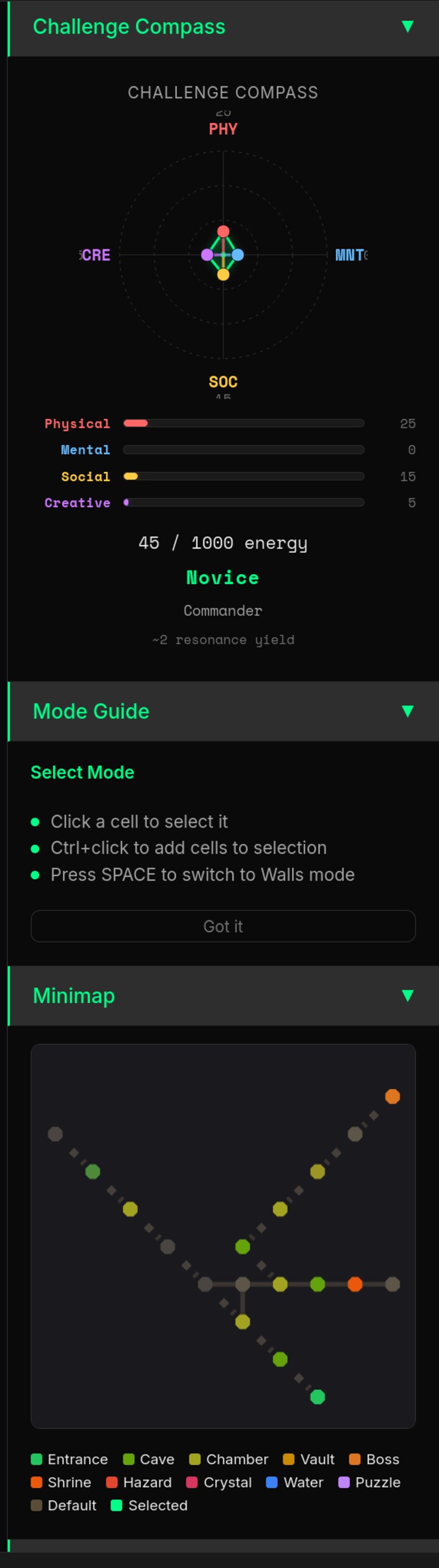
A four-axis radar showing the shape of the experience you're building. Not a budget bar — a balance reading.
Why a Compass, Not a Meter?
A single-number budget ("you've used 650 of 1000 energy") tells you how much you've built. It doesn't tell you what kind. A dungeon stuffed with 40 enemies and a dungeon stuffed with 40 puzzles have the same energy cost and completely different feel.
The Challenge Compass is a four-axis radar. Every cell you place, every piece of content, every room type contributes to one or more axes. The polygon that connects them shows you the shape of the experience. Balance is visible, not computed.
The Four Axes
⚔ Physical
Combat, motion, survival. Driven by enemies and combat-oriented cell types (Arena, Boss Throne, Guard Post).
🧠 Mental
Puzzles, traps, navigation. Driven by traps and cognitive cell types (Puzzle, Library, Gauntlet).
👤 Social
Negotiation, role, encounter. Partially driven by loot (reward framing invites social stakes) and narrative cell types.
🎨 Creative
Expression, decoration, atmosphere. Driven by decorations, props, and aesthetic cell types (Shrine, Crystal Cave, Mushroom Grotto).
The mapping is intentionally coarse. Content doesn't belong to one axis exclusively — loot splits between Creative and Social, a trap in a puzzle cell touches both Mental and Physical. The compass smooths it out; you see tendencies, not pixel-exact scores.
How the Compass Is Drawn
The compass lives in the bottom-right corner of the editor as a 200×200 SVG. Four spokes radiate from center at 90°. Each spoke's length is proportional to its axis score. A translucent polygon connects the four spoke tips — the shape that polygon takes is the shape of your dungeon's experience.
- Perfect square — balanced across all four axes. Rare. Usually means the dungeon tries a little of everything.
- Long on one axis — committed to a single experience type. A combat dungeon, a puzzle dungeon, a shrine complex.
- Kite shape (two long, two short) — a focused dual experience. Combat + puzzles. Social + creative.
- Tiny polygon near center — sparse. You haven't placed much yet, or you're building an atmospheric dungeon with no explicit challenges.
Tier Labels
Total compass area maps to a tier label — a quick summary of how much there is regardless of balance. The default cap is 1000 energy; each band is 200 wide:
| Tier | Energy Range | Feel |
|---|---|---|
| Novice | 0–200 | A single encounter or a quiet walk. |
| Adventurer | 200–400 | A short dungeon. One set piece. |
| Veteran | 400–600 | Several rooms. Multiple encounter types. |
| Expert | 600–800 | Substantial dungeon. Full experience. |
| Legendary | 800–1000 | A marquee dungeon. The players will remember it. |
| IMPOSSIBLE | > 1000 | You've exceeded the budget. Label turns red. |
Below the tier label, two additional readouts:
- Archetype label — a named shape describing your current polygon. A Physical-dominant dungeon reads as Commander; a Creative-dominant shrine reads as Sage; a balanced-but-shallow dungeon reads as Novice Explorer. The archetype gives you a one-word summary of what kind of experience you've composed.
- Resonance yield — expressed as ~N resonance yield. A rough estimate of how much reward signal the dungeon emits per play. Low yield on a big Physical spike means "lots of combat, little payoff" — a sign to add loot or ease the difficulty.
What Costs Energy
Every active cell and every placed content item contributes. Cell types cost energy inherently (a Boss Throne cell costs more than a Passage). Content items have the costs listed on Content & Traps. The compass recomputes every time you place, remove, or change a cell's type.
Going over 1000 isn't blocked — the label just reads IMPOSSIBLE in red. That's a warning that your dungeon may be exhausting to play, not that the editor will stop you. You can ship a 1200-energy marathon if that's what you want. The compass tells you; you decide.
Using the Compass as a Design Tool
Two workflows fall out naturally:
- Design to shape. Pick the polygon you want first — "I want a combat dungeon with a little narrative" means a long Physical spike, a short Social spoke, and small Mental/Creative. Then place content until the compass matches.
- Design to feel, check against shape. Build the dungeon that tells the story you have in mind. Glance at the compass. If the shape surprises you — "I thought this was a puzzle dungeon but Mental is the shortest spoke" — that's useful information. Adjust or commit.
Good game design has balance. Great game design has deliberate imbalance. A shrine-heavy dungeon that spikes Creative and starves everything else isn't broken — it's committed. The compass helps you see the commitment so you know it's a choice.