Content & Traps
The 18-item palette. What each does, what each costs, where each belongs.
The Content Palette
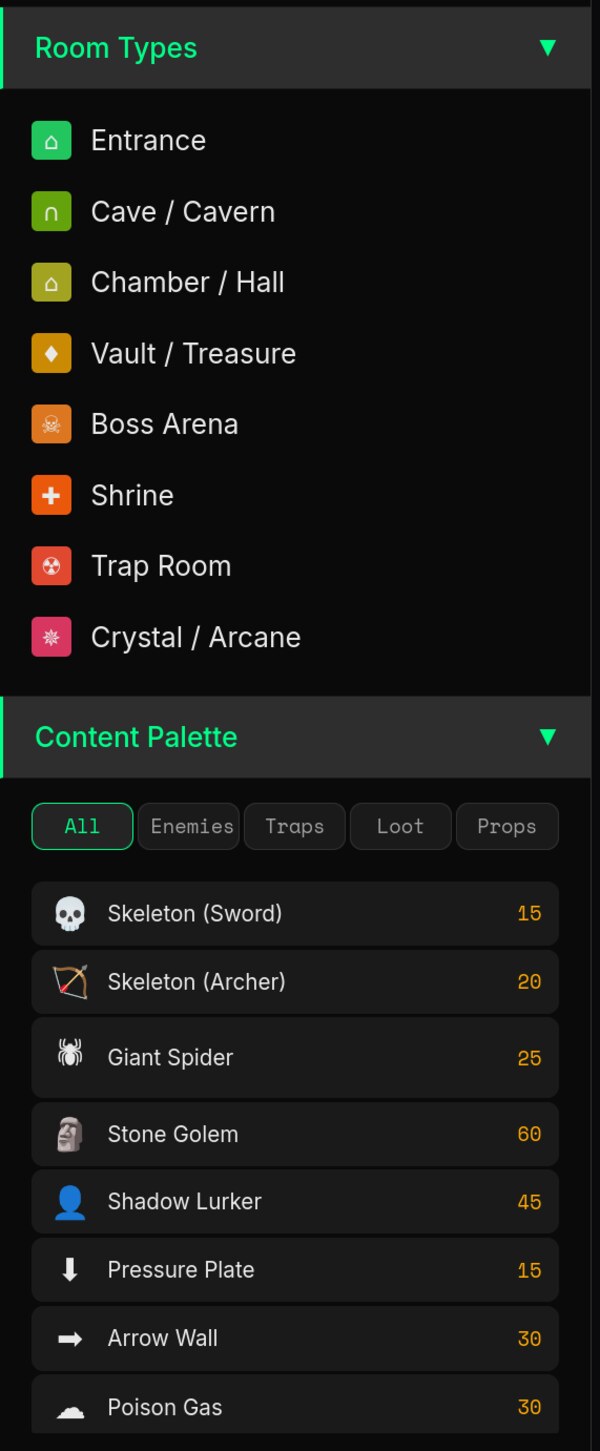
Switch to Content mode (SPACE cycles). The palette lives on the left sidebar and splits into four filter tabs: Enemies, Traps, Loot, Props (plus All). Click an item to select it (cursor becomes “grab”), then click a valid cell to place it. Each item shows its icon, name, and energy cost in orange. If a placement is invalid, DM shows you why instead of silently failing.
Enemies (5 types)
Enemies drive the Physical axis on the Challenge Compass. Each costs energy proportional to its threat. All five are octagon-only — connector diamonds are too small for an encounter.
| Item | Energy | Where | Notes |
|---|---|---|---|
| skeleton_sword | 15 | octagon | Melee baseline. Pack-friendly. |
| skeleton_archer | 20 | octagon | Ranged. Pair with cover. |
| spider | 25 | octagon or connector | Small enough for corridors. |
| shadow_lurker | 45 | octagon | Ambush encounter. Dark rooms. |
| golem | 60 | octagon | Mini-boss. One per room. |
Placement limits: max 8 enemies per octagon. No enemies in safe zones (Shrine, Entrance).
Traps (5 types)
Traps drive the Mental axis. Placement is a puzzle of geometry — where does the player have to walk, where do they naturally pause? Most traps are octagon-only; two can go in corridors.
| Item | Energy | Where | Notes |
|---|---|---|---|
| pressure_plate | 15 | octagon or connector | Triggers on weight. Pairs with another trap. |
| arrow_wall | 30 | octagon | Volley from an adjacent wall. Needs line of sight. |
| poison_gas | 30 | octagon | Area hazard. Lingers. |
| alarm | 40 | octagon or connector | Alerts nearby enemies. Force multiplier. |
| flame_jet | 50 | octagon | High damage, obvious tell. Skill check. |
Placement limits: max 3 traps per octagon, max 1 per connector. No traps in safe zones.
The DM editor stores only the trap's placement — its ID, position, trigger type, and effect type. The runtime mechanics (damage, VFX, audio) live in poqpoq World and are driven by the Luminary archetype system. That's why traps look like simple icons in DM but feel reactive in play.
Loot (4 types)
Loot drives the Creative and Social axes — reward shapes the feeling of a dungeon as much as its difficulty does. All four are octagon-only (a connector is too cramped to stage a reward).
| Item | Energy | Notes |
|---|---|---|
| barrel | 5 | Flavor loot. Breakable. |
| chest_wooden | 15 | Standard reward container. |
| chest_ornate | 30 | Major reward. One per room, ideally. |
| pedestal | 40 | Quest or artifact anchor. Centerpiece. |
Props (4 types)
Props are atmospheric — they don't fight, don't reward, don't block, but they make rooms feel inhabited. They register lightly on the Creative axis.
| Item | Energy | Where | Notes |
|---|---|---|---|
| torch | 5 | octagon or connector | Wall-mounted. Reads as light source. |
| pillar | 10 | octagon | Structural. Breaks sight lines. |
| cage | 10 | octagon | Narrative prop. Prison, captive, empty. |
| altar | 20 | octagon | Pairs with Shrine cells. |
Trap Anatomy
Under the hood, every trap is three choices:
- Trigger type:
pressure_plate,tripwire,proximity,timed,interaction - Effect type:
spike,arrow,pit,poison_gas,boulder,flame_jet,cage,alarm,magical_rune - Visibility:
obvious,hidden,invisible
The palette items are pre-configured combinations of the three. Advanced editing of the triple is exposed in the properties panel once a trap is placed.
Placement Rules at a Glance
- Only active cells accept content. Activate a cell in Select mode first.
- Safe zones (Shrine, Entrance) refuse enemies and traps. Loot and props are fine.
- Connector diamonds accept only spider, pressure_plate, alarm, torch. Everything else is octagon-only.
- Per-octagon caps: 8 enemies, 3 traps. Per-connector cap: 1 trap.
- Loot and props have no hard cap, but the Challenge Compass will tell you when the balance is off.
A room with five enemies and zero loot trains players to fear the space. A room with zero enemies and five chests trains them to expect reward without risk. Neither is wrong, but the Challenge Compass will show you when you've committed to one extreme. Balance isn't mandatory — it's visible.