My video walkthrough, Making a World Feel Alive in Your Browser, showed the new ground cover on Savannah One. The grass there is built from cards: flat rectangles with a picture of grass on them, scattered across the terrain. That is an old, honest technique, and it is easy to do badly. Here are the three things that made ours work, and one bonus.
1. Optimization is 90% about the alpha
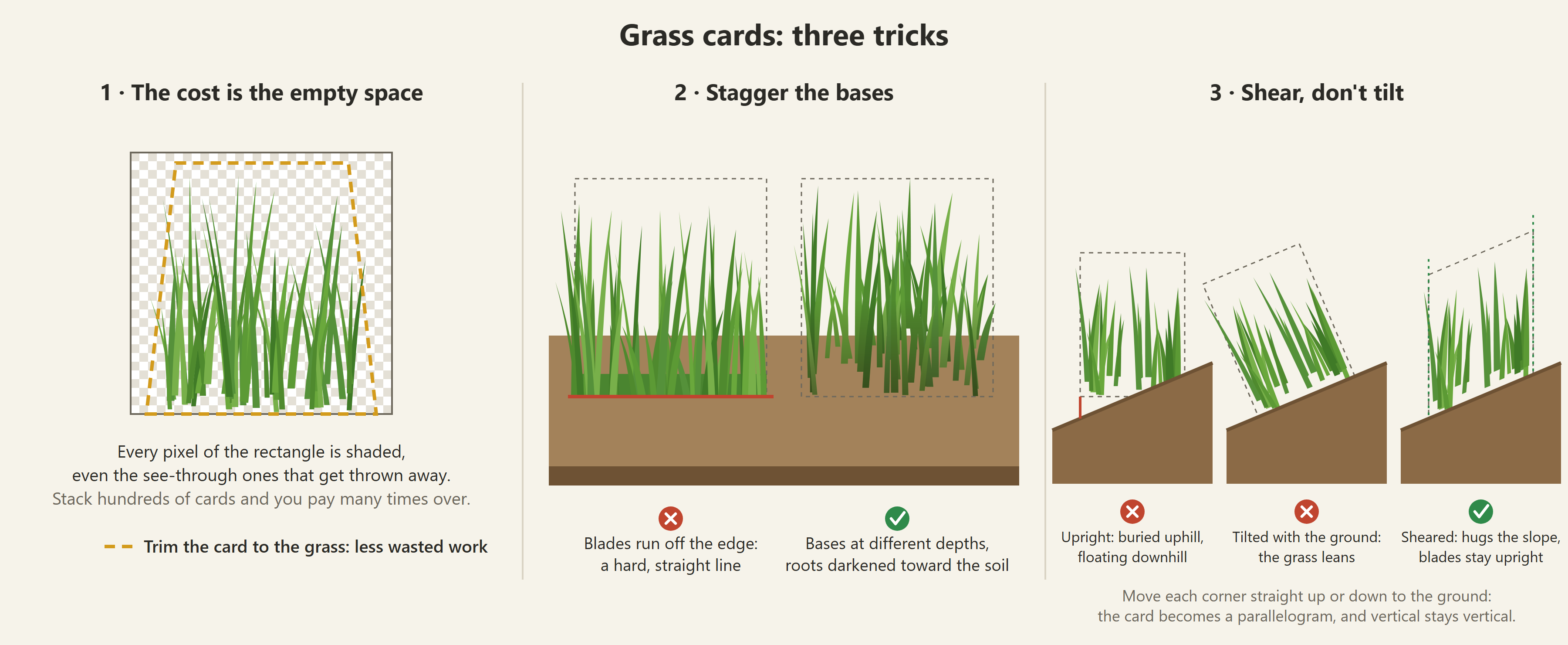
Grass cards are mostly empty space. Each card is a rectangle with a few blades painted in, and the GPU pays for every pixel of that rectangle, including the transparent ones it throws away. Stack hundreds of cards behind each other and you pay that cost many times over for the same spot on screen. That is called overdraw, and it is the real bill.
When we measured, roughly 60% of the pixels the grass shader worked on were transparent corners that got discarded. So most of the work went there: a simpler material, fewer cards as distance grows, and thinning the field wherever the eye won't notice. On a laptop's integrated graphics, that is the difference between grass you can afford and grass you can't.
The next big step is trimming the cards to the shape of the grass inside them, so the GPU stops shading empty air. That is the dashed gold outline in the first panel.
2. Stagger the bottoms of the cards
If every blade on a card runs straight off the bottom edge of the texture, you get a hard horizontal line wherever the card meets the ground, and the eye finds those lines instantly. Instead, the blade bases sit at different heights inside the card, as if you were looking back through rows of grass in depth. The bottom edge goes soft, and the grass seems to come out of the ground instead of standing on it.
Darkening the roots toward the soil color helps too. It hides the seam and reads as shadow down among the blades.
3. Shear the cards to fit the slope
Terrain is almost never flat, and a flat card on a slope has two bad options. Keep it upright, and it cuts into the hill on the uphill side, so the bottom is chopped off at an angle. Tilt it to match the ground, and the grass leans sideways. Plants don't grow that way, and you notice.
The fix is a shear rather than a rotation. Each bottom corner of the card drops to the ground height under it, and the top moves by the same amount. The card becomes a parallelogram that hugs the slope, and because points only move straight up or down, every blade still points straight up. It is like squishing putty instead of tipping a board.
It's a small piece of math, and it made the ledges and sideways grass disappear.
Bonus: break the grid
Every card gets its own random rotation, size, color variation and a slightly different phase in the wind. The eye is very good at spotting repetition, and that randomness is what keeps it from noticing the cards.
See it live, and what's next
Open Savannah One in pOqpOq World and walk around (sign in with Google first): the link turns the grass on. Look along the ground where a slope rises, and at the places where the grass meets bare soil. That's where the second and third tricks earn their keep.
Next up: brushes, so sim owners can paint where grass grows.
— Allen