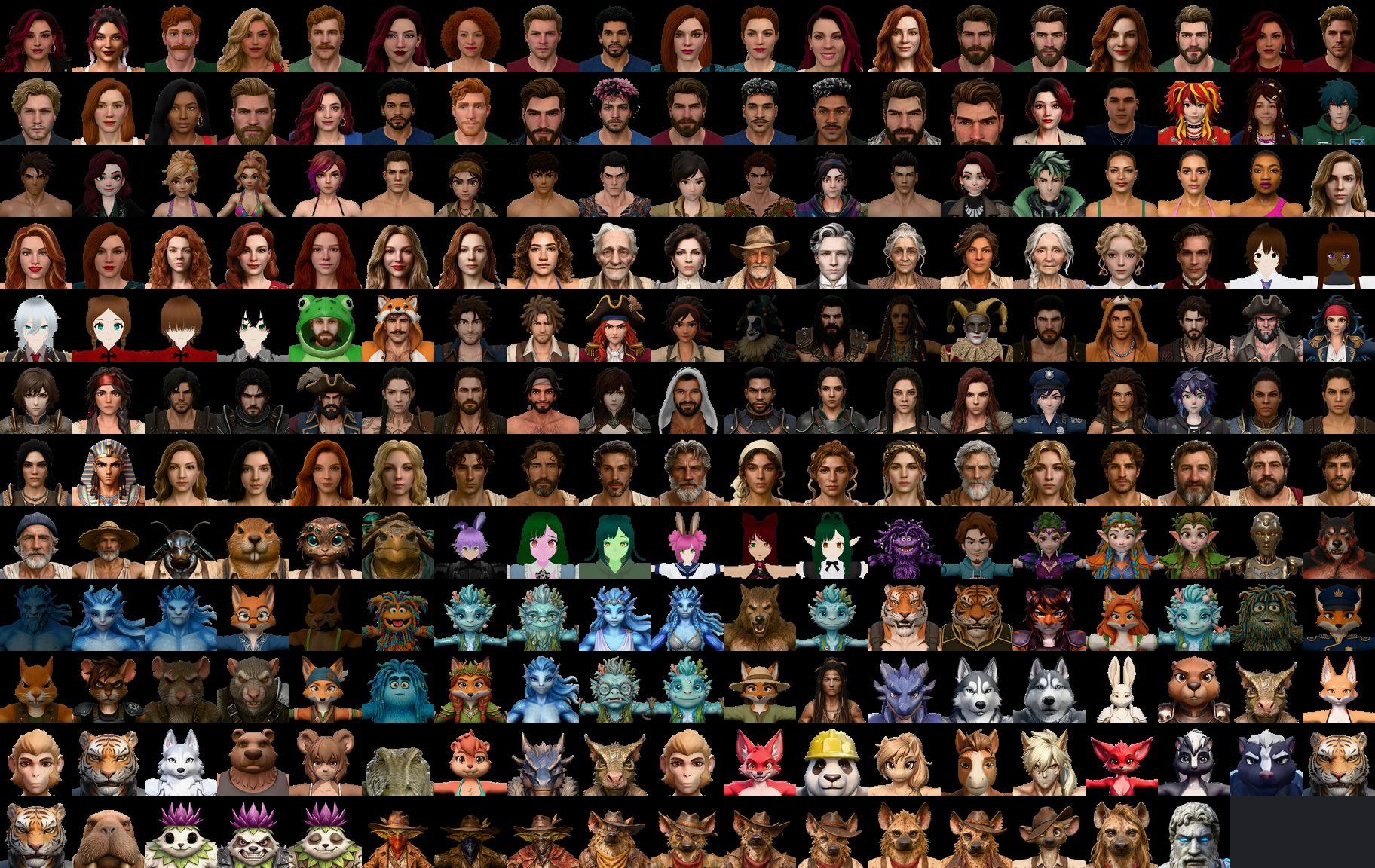
A month ago I introduced Harry as the tool that moves an animation from one skeleton to another. Since then Harry has become the door every character walks through before it reaches pOqpOq. Drop in a 3D model, and Harry checks it, repairs it, photographs it and hands it to the world.
It would be easy to stop there and say “Harry makes them better.” But the interesting part is why a body needs fixing at all, and why some of these small repairs matter so much more than they seem to. So here are a few of them, explained.
Why a body breaks when it moves
A 3D character is a hollow shell over an invisible skeleton. Every point on that shell is pinned to one or more bones, and when the bones turn, each point follows a blend of the bones it belongs to. Most of our characters come from AI generators and automatic riggers, which pin each point to whichever bone is closest. Standing still, that looks perfect.
The trouble starts at the joints. When a joint bends, the blend takes a shortcut: it draws a straight line across the inside of the bend instead of following the curve of the flesh. So a bending limb loses volume, the way a garden hose flattens when you kink it. Your eye catches that instantly, even if you can’t say what’s wrong. It is the difference between a person and a rubber toy.
Elbows and knees: why the crease matters
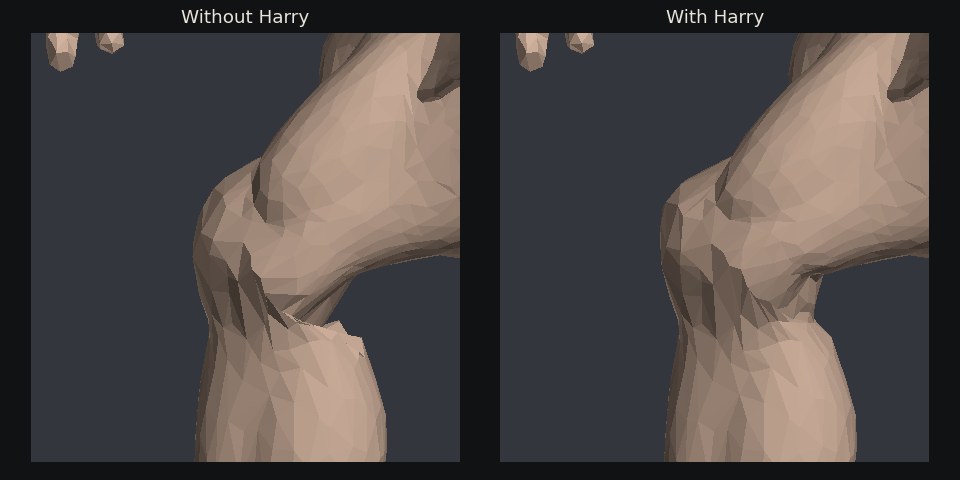
Watch your own arm bend. The point of the elbow pushes out, the skin folds neatly on the inside, and the forearm stays exactly as thick as it was. That fold, the crease, is what tells you a real joint is there. Lose it and the arm reads as a bendy straw.
Harry gives every elbow and knee a hidden helper that turns half as far as the joint does. The flesh around the joint follows the helper, so the bend stays round instead of pinching. Measured on our characters, it cuts the collapse at the elbow to a third and halves it at the knee.
Muscles: why the bulge matters
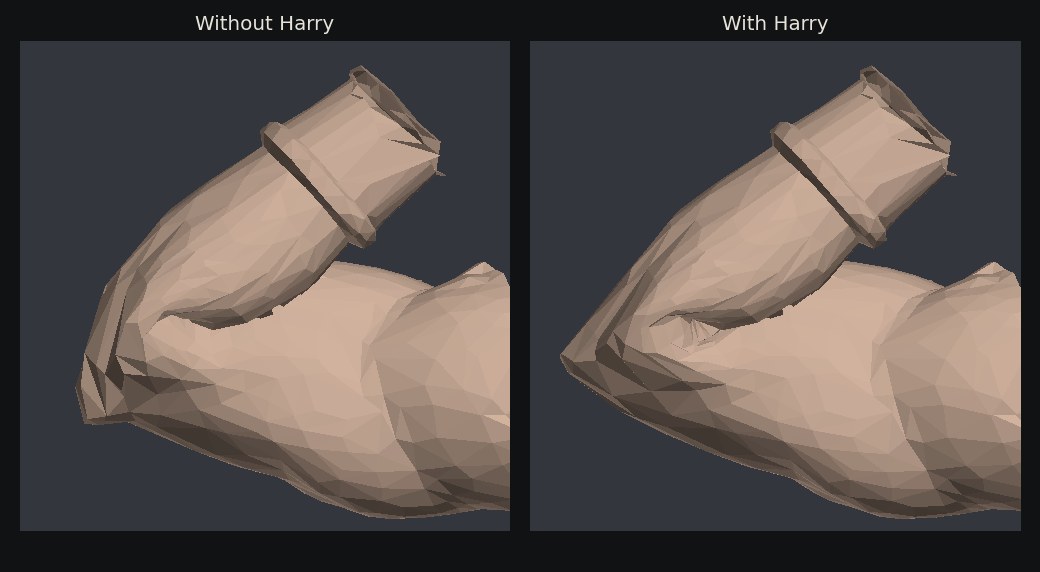
Now bend your arm again and watch the biceps. It bunches up. The muscles of the forearm swell as your fingers grip. That bulge is how we read strength, effort and intention: a character lifting something heavy looks like it is working. Without it, a moving arm looks like a shop mannequin’s.
So Harry adds small muscle helpers to each arm, one for the biceps and one for the forearm, which swell as the elbow bends. They are sized from each character’s own arms, because a slender dancer and a barbarian do not bulge the same way. 138 of the bodies on the roster carry them today.
Holding the core shapes
We recognise a character from a long way off by its silhouette, and the core of the silhouette is the torso: the chest, the shoulders, the hips. If those shapes wobble or cave in as the character moves, the whole figure feels unstable, even when every limb is animated well.
When we measured our generated characters, we found that the riggers had pinned the whole upper chest to the collarbones. Every time the shoulders moved, the chest caved inward, and up to a fifth of its volume vanished. No amount of adjusting the arms helped, because the arms were never the cause. Harry now repairs the chest of every body on the way in, so it holds its shape whatever the arms do. It also seats the head on the neck the way a real head sits, so characters don’t peer down at the floor.
Skirts: the one we found today
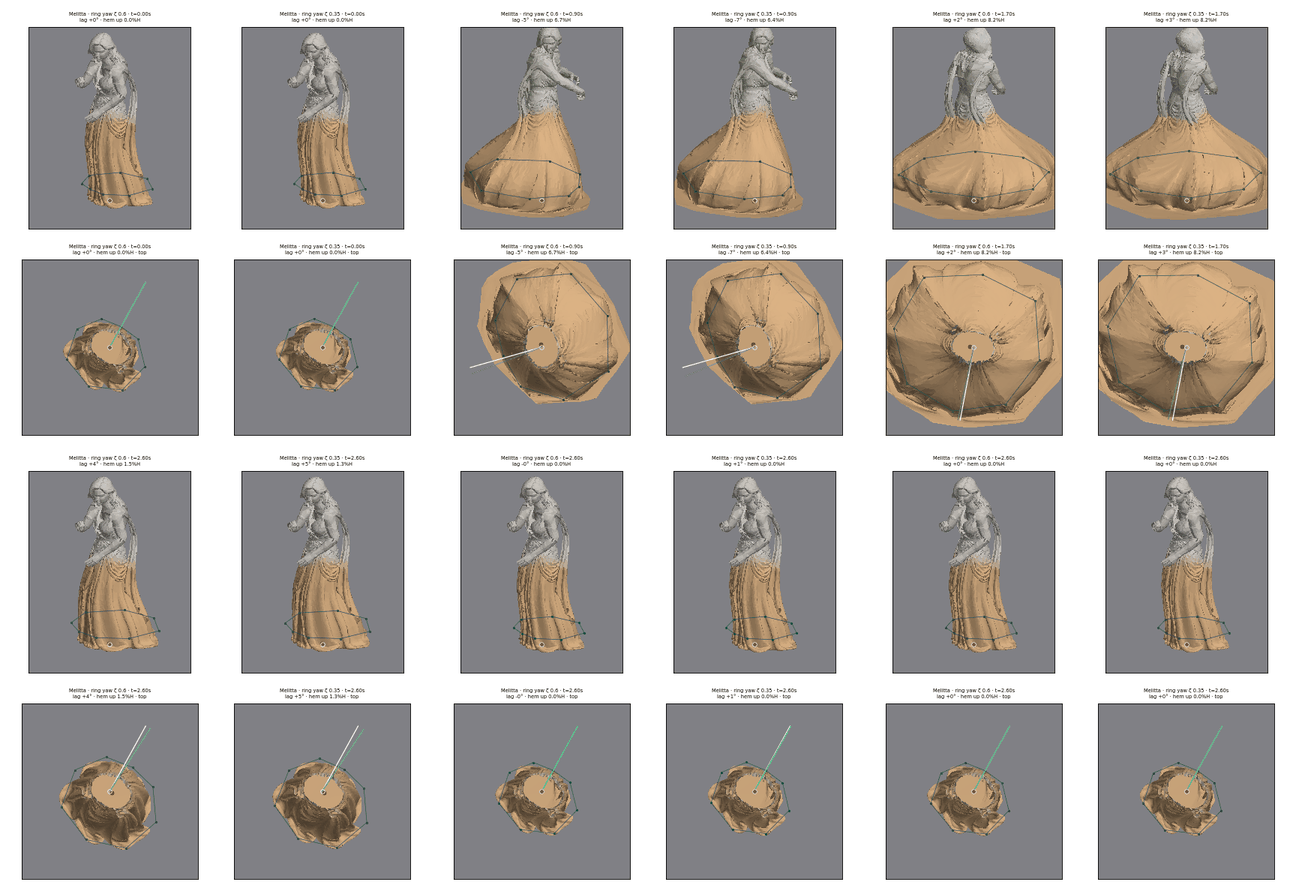
Here is a fresh one. This morning I noticed that the long dresses in the plaza looked odd when their wearers walked. When we measured, the reason was striking: the riggers had pinned each half of every long skirt to one leg, so the dress walked like a pair of trousers. With every step it split down the middle, and its hem rose with the knees by as much as a fifth of the character’s height.
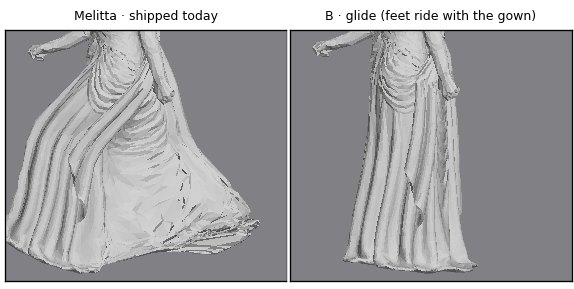
Harry now finds a long skirt by the cloth that wraps all the way round both legs, and re-hangs it from the hips, where a skirt really hangs. It found 14 long skirts across the whole roster, and that fix is on its way in.
The next step is the fun one. Picture a plumb bob hanging under the hips: the hem hangs from it, gravity keeps it down, and it sways when the character starts, stops or turns. Spin, and the skirt should flare out, swing past and swing back. That is the moment everyone loves about a dress, and a ball gown most of all. Here is our very first test of it:
And the rest, quickly
- Hands. Many generated characters arrive with mitten hands. Harry grows them fingers, so they can point, wave and hold things.
- Holding things. Harry works out how each character’s hand should close around a sword, a staff, a wand or a crystal ball.
- Bounce. Hair, tails and soft tissue move with the character instead of riding along like stone (more here).
- Eyes that look back. The characters in the world now notice you and glance your way. That one gets its own post soon.
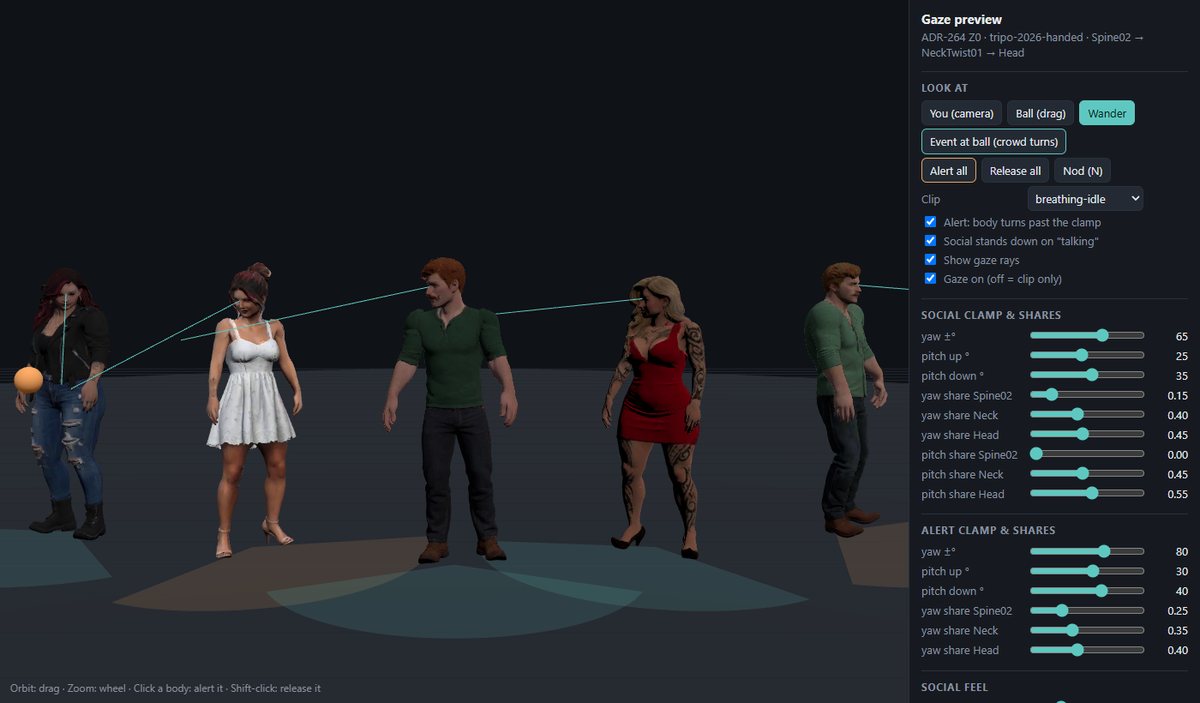
A crowd turning to look at the same thing, in the gaze tuning studio. - 918 moves. Every body shares one animation library, now including eating, drinking, nodding, shrugging and thinking.
- One click to the world. Harry photographs each character, sizes it, shrinks its textures for the web, and sends it to the roster. A batch of 81 more is on the way.
None of this is visible when a character stands still. All of it is visible the moment it moves. That is what Harry is for.
— Allen