Canonical Records — The Architecture of Persistence
When more than ten different code paths can create the same kind of object, each one grows its own implicit schema for what to write. The result is a class of bugs we ended up naming: parallel tracks that look unified but live in separate worlds.
The Problem
A virtual-world object — a chair, a wall, a torch, anything a user can place — can be born through more than ten different code paths. Users create them through the build tool. Users duplicate them with a keyboard shortcut. Worlds import them in bulk from another platform. Players pull them out of inventory. Builders upload mesh files. Generative systems scatter them across terrain. Scripts spawn them at runtime. Future AI companions create them via tool commands.
Each of those paths was written at a different time. Each was written while a different problem was being learned. Each quietly evolved its own implicit answer to the question what does a record of this object look like? — and none of them ever sat down together and agreed.
What Goes Wrong
When paths disagree, bugs that look unrelated turn out to be instances of one pattern. A user creates a textured cube with the build tool: the texture renders perfectly until the page reloads, at which point the cube is gray because the create-path quietly dropped the texture data. A duplicate of the same cube loses its colors after a multi-user broadcast. A linkset of objects imported from another world disappears from one place when deleted in another, because the deletion code walked the wrong index.
Three independent bug reports. One underlying pattern.
This is the sister to the cross-engine bridge problem in the previous chapter. There, two systems disagreed about a single convention, and the disagreement got pasted into a transform field that seven readers consumed. Here, ten paths inside one system disagree about what fields to write, and the gaps surface only when a downstream consumer walks state that one path produced but another path didn't.
The Audit
We did the natural first thing: we wrote a 754-line audit walking every column of the object table, every field of its metadata, every code path that wrote to either. The audit's purpose was not to fix anything. Its purpose was to make the asymmetric pattern visible — to tabulate which fields each path emits, so the gaps are no longer findable only after a user reports a bug.
The audit's most valuable output was not the list of bugs. It was the realization that every bug fit into one of four classes — and the class determined what kind of fix was needed.
Four Classes of Asymmetry
Birth-channel write asymmetry
The same field is emitted on path A and dropped on path B at write time. The user sees the difference at reload, when path B's incomplete state is what the system loads back. Fix shape: canonical record type that all paths must satisfy.
UI without persistence
A control exists in the interface, the user clicks it, nothing in storage changes. The handler was wired halfway: from button to function but not from function to database. Fix shape: trace the path; close the gap or remove the control.
Persistence without UI reflection
The database has the data. The renderer shows it. The inspector reads from a third source and shows nothing. The user sees the texture painted on the object but the edit panel claims the object has no texture. Fix shape: single-source the inspector against the same payload the renderer reads.
Cleanup walks the wrong index
Destroy or lifecycle code keys on a column that doesn't match the actual scope. Objects from one place get swept along with objects from another, because the cleanup query couldn't tell them apart. Fix shape: scope every cleanup query by every relevant predicate — never trust single-column matching for "is this referenced elsewhere?"
Two observations make this vocabulary load-bearing.
Classes 2 and 3 are inverses. Class 2 has user intent that doesn't reach storage; Class 3 has stored data that doesn't reach user intent. Together they surround a missing piece in the domain model. Ratify a canonical record type and the canonical channel that writes it, and both classes close at once.
Only Class 4 destroys data. The other classes produce visible inconsistency — missing textures, lost colors, blank inspectors. Class 4 is the one where things disappear. Cleanup queries that match too loosely don't just hide content; they remove it. Class 4 deserves the most caution because by the time the symptom is visible, the data is already gone.
The Decomposition That Made The Type Tractable
Once the audit was complete, the obvious next step was a canonical record type that every path would write through. The temptation was to make it one flat record with all forty fields. The right decomposition was already sitting in the build tool's user interface.
Every object in the build tool is editable across five tabs:
Each tab owns a distinct slice of the object's state. That mapping isn't arbitrary — it's how the user already thinks about the object. Shape is the geometry. Look is materials and textures. Physics is collision and gravity. Code is scripts and contents. Own is name, description, attribution, license. Plus the implicit Transform layer that the gizmo edits, and the system-managed Structural layer for identity and linkset binding.
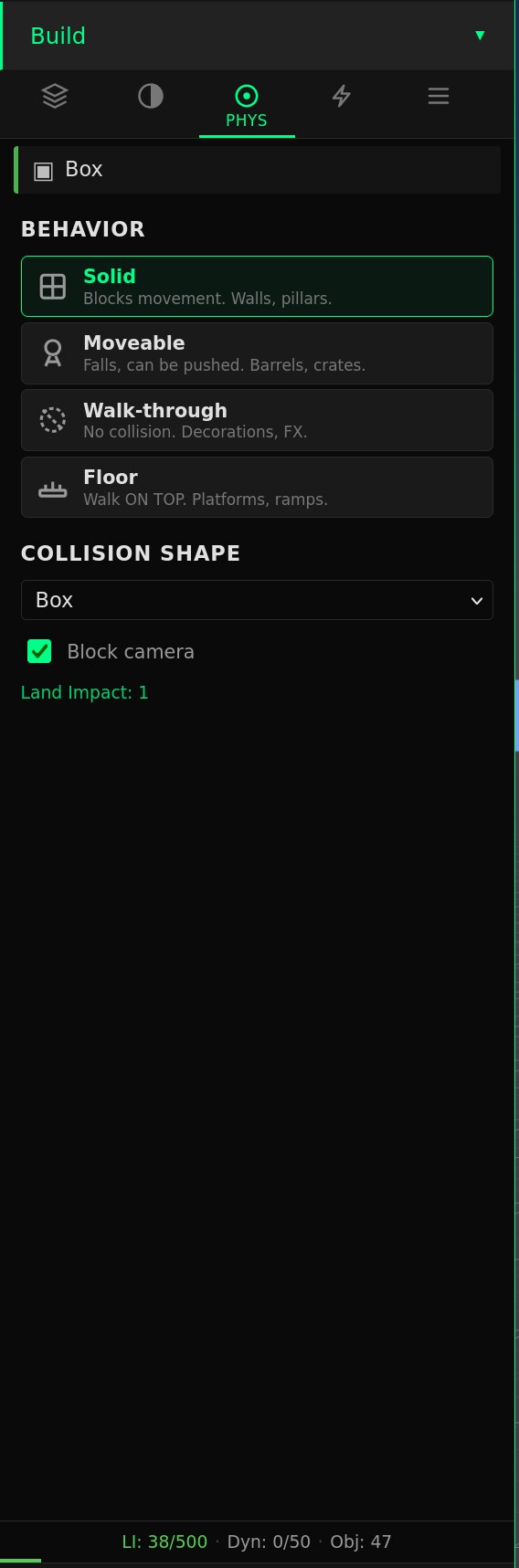
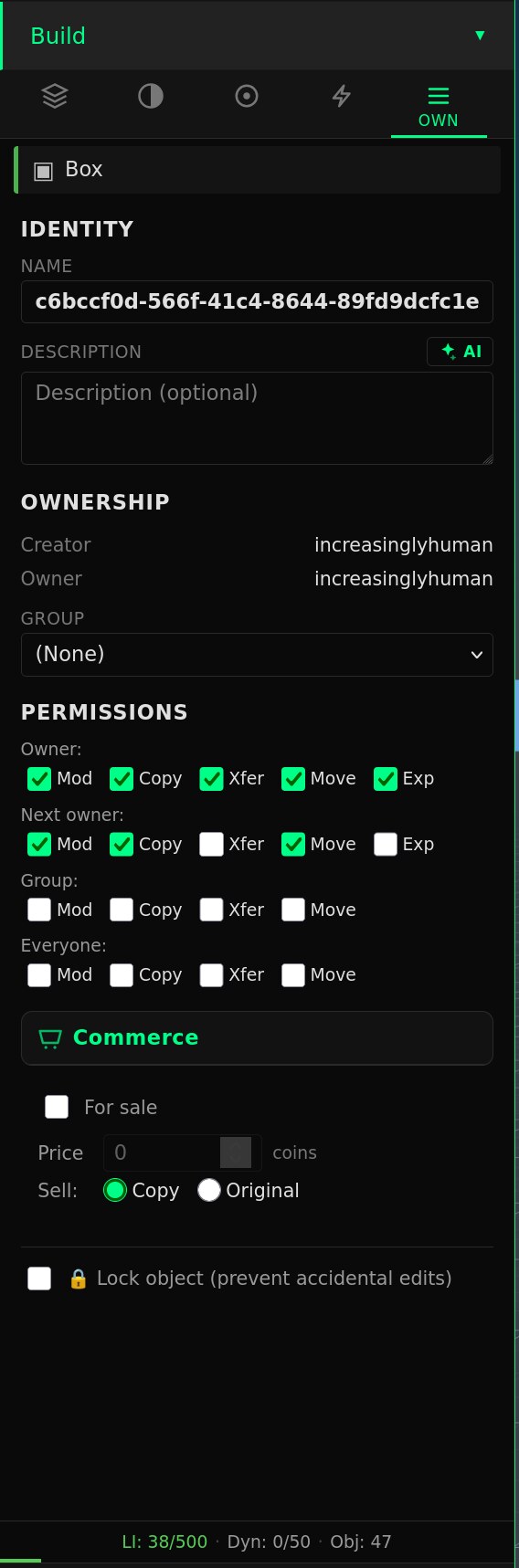
The canonical record carries one sub-record per slice. The bug class then maps cleanly: "duplicate loses materials" becomes "duplicate drops the Look sub-record." "Imported objects lose creator attribution" becomes "import drops the Own sub-record." The scattered bugs across forty fields collapse into a handful of per-slice gaps with one obvious shape: make every birth channel write every sub-record.
The Channel Equals The Broadcast Equals The Permission Gate
A subtle but load-bearing property of the architecture: the channel that persists an object's state is simultaneously the channel that broadcasts it to other users, and simultaneously the channel where permission gates apply.
When a builder creates an object, three things happen with the same payload:
Persist.
The builder's client sends the payload to the multi-user backend, which writes it to durable storage. This is the "remembered on reload" channel.
Broadcast.
The backend emits an event to every other client in the same world. This is the "everyone sees the new object immediately" channel.
Recreate (later).
When the builder — or anyone else — reloads the world, the stored record is read back and used to reconstruct the object. This is the "permanence" channel.
If the payload is incomplete, all three suffer. L->>DB: Read payload DB-->>L: (whatever was persisted) L->>L: Recreate object
All three operations consume the same data shape. If a birth channel drops the Look sub-record, then:
- Stored state is incomplete — no colors, no textures, no material info.
- The broadcast to other clients is incomplete — their screens render gray even while the creator's screen shows the painted object.
- Reload renders gray for everyone — the same reconstruction code reads the same incomplete record.
Three apparent bugs — "single-user reload regression," "multi-user sync bug," "broadcast-fidelity bug" — reduce to one structural defect. Fixing the channel fixes all three. The architectural rule that falls out of this:
The same channel is also where permission gates live. When a user tries to build in a world that they don't own without explicit permission, the canonical channel rejects the write. When a script tries to spawn an object, the canonical channel verifies the script's owner has rights. When an AI companion uses a tool to place an asset, the same gate applies. The channel is the permission boundary, not a thing every caller has to remember to check.
Asset Is The Hub
Most canonical records reference other canonical records. Objects reference their geometry asset. Inventory items reference their underlying assets. Worn attachments wrap inventory. Environments reference textures. NPCs are mesh-backed assets. Avatars are bone-rigged assets. Terrain layers reference texture assets. Drawn as a graph, one record type sits at the center, and every other points at it:
storage + identity
+ license attribution"] PRIM["Object Record
(placement)"] INV["Inventory Item"] UATT["Worn Attachment"] HATT["HUD Attachment"] ENV["World Environment
(water, sky, terrain)"] NPC["NPC Record"] AVA["Avatar Appearance"] SCAT["Scatter Manifest"] PRIM -->|references| ASSET INV -->|references| ASSET UATT -->|wraps| INV HATT -->|wraps| INV ENV -->|texture refs| ASSET NPC -->|mesh + animation refs| ASSET AVA -->|body-part refs| ASSET SCAT -->|collection refs| ASSET classDef hub fill:#1e1e1e,stroke:#0099ff,stroke-width:3px,color:#0099ff classDef record fill:#2a2a2a,stroke:#404040,color:#e0e0e0 class ASSET hub class PRIM,INV,UATT,HATT,ENV,NPC,AVA,SCAT record
Once the asset record is canonical, every record that references it inherits stable identity, license attribution, and reference counting. The pattern that ratifies the object record can be cloned for each downstream type: empirical audit, canonical record, single persistence channel, migrated paths. What gets ratified is a template, not just a contract for one table.
What This Costs
Ratifying a canonical record across ten-plus paths is not cheap. The paths were built at different times, by different authors, against different states of the surrounding system. Each path's owner has invested in their path's idiosyncrasies; some of those idiosyncrasies turn out to be load-bearing.
The discipline that makes the cost manageable:
Audit before refactor.
Write the full asymmetry tabulation before writing the canonical type. The audit's job is to make sure the type covers everything that's already in the field. Without the audit, the type becomes another implicit schema.
Walk the audit with someone who built the paths.
Static audits miss the runtime nuance that built up over months. Walking the audit with the people who shipped each path surfaces the load-bearing idiosyncrasies the static read missed. "Why is this field this way?" is the question that catches the gaps.
Migrate path-by-path, behind the channel.
Don't migrate everything at once. Ratify the canonical channel first; let new paths use it; migrate old paths one at a time. The old data stays valid until the path that wrote it is replaced. Big-bang migrations break things no audit caught.
Lock the type with comprehension gates.
The biggest risk after ratification is a new path that grows its own implicit schema. A pull-request review question of "does this path write through the canonical channel?" prevents that drift cheaply. Constitutional rules need operational forms.
Why It Matters Beyond One Object Type
The pattern this chapter described — parallel paths that look unified but live in separate worlds — recurs across every persistence domain in a complex system. The bug fingerprint is always the same: a field is present on some records and absent on others, no error is raised, a downstream consumer notices the gap in a way that looks like an unrelated symptom.
The discipline that resolves it is reusable: audit, decompose, canonical type, single channel, migrate behind the channel, comprehension gate. Object records. Inventory items. Worn attachments. World environment. NPC. Avatar appearance. Each is a future audit in the same shape, and the methodology is the work you only have to do once.
What's Next
The third chapter in this set turns from data persistence to interaction persistence — specifically, the design rule that prevents user interfaces from accidentally trapping people in states their workflow didn't anticipate.